

Pages

Wednesday, August 25, 2010

Benefits of Tri-mode Pressure Washers

by

Super Max15200
Tri-mode pressure washers offer a variety of advantages over other pressure washing equipment. Because of their advantageous versatility and cleaning power, many professionals choose tri-mode machines, enabling them to complete a wide range of job applications include auto detailing, degreasing, and equipment cleaning.

What Are Tri-mode Machines?

Conventional pressure washers provide only one or two kinds of output: heated and non-heated. Hot water output can reach a maximum of 210°F, while non-heated machines disperse water at room temperature or inlet temperature. Tri-mode machines, on the other hand, can provide three types of output: cold water, hot water, and steam. The added advantage of steam temperatures up to 330°F helps soften stains created by dirt and grease.

For added cleaning power, tri-mode machines by Daimer® are offered with pressure levels up to 3500 psi. This enables operators to soften the most challenging deposits while blasting them away with high powered output. For lighter applications or for cleaning heat-sensitive surfaces, cold water and hot water modes can also be used. This versatility ensures the right level of output for virtually all applications.

Advantages

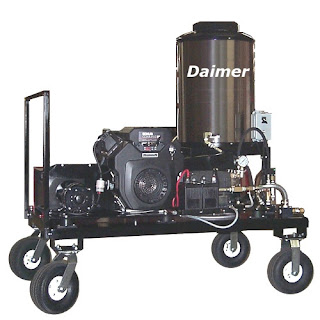
The main advantage of tri-mode pressure washers is their versatility. One such machine, Daimer®’s Super Max™ 15200, includes tri-mode capabilities along with pressure levels of 1000 psi and a flow rate of 2 GPM. This machine is ideal for auto detailing, cleaning factory floors, and cleaning other hard surfaces in areas where mobility isn't necessary, as this machine is stationary. However, utilizing Daimer®’s Long Hose Technology, operators of this stationary pressure cleaner can reach areas up to 300 feet away. Optional multi-gun operation enables two people to use the pressure washer at the same time to quicken the cleaning process.


Monday, August 2, 2010

Pressure Washing Boats to Achieve Total Cleanliness

by


Boats tend to collect as much dirt as trailers and cars. Salt present in the water can damage boats beyond repair if you do not remove it on a regular basis. Salt reacts chemically with metals such as aluminum, leading to corrosion of metallic pipes and parts. It can also ruin the look of glass parts and create a blurriness that is difficult to eliminate.

Salt is also highly damaging to painted surfaces because of its sandpaper-like qualities, which can strip off paint. There are other types of residues on the boat that must be removed as well, including: grease, fuel oil, and marine life such as algae and barnacles on the hull. Because of the difficulty in cleaning boats, pressure washers are often preferred over other cleaning methods.

Toxic detergents usually contain bleach, which can harm a number of surfaces on the boat. Bleach may also leave discoloration stains on metal, wood, and other surfaces. Using a high power pressure washer reduces the need for detergents. Pressure washers also offer faster cleaning times and more effective cleaning than manual scrubbing. If you need to use detergent to handle more challenging applications, use a green chemical such as Daimer®’s Eco-Green® line of chemicals, which are natural, bleach-free, and non-toxic.

For difficult cleaning, it is recommended that you invest in hot water pressure washers. Pressure washers that use heated water or wet steam, as available in Daimer®'s Super Max™ and Vapor-Flo® lines, speed up the cleaning process. They are very effective at removing grease, chemicals, and odors. However, basic cleaning of the outside of the boat may be done by cold water machines with adequate pressure levels. If more cleaning power is needed, a green cleaner, such as Daimer®’s Eco-Green® Multi-Purpose Hard Surface Cleaner, can be applied.


Wednesday, July 14, 2010

Pressure Washers are Essential Machines for Public Works Departments

by


Pressure washers are necessary machines found in public works departments for cleaning streets, highways, and sidewalks. These powerful cleaning machines are suitable for rough use on hard and rugged surfaces. Just like with other consumer products, the quality and effectiveness of pressure washing machines vary across different brands. The following are some tips to select the most suitable product for cleaning streets, pavement, roads, and other public places.

Mobile versus Stationary
Mobile pressure washers are more suitable for cleaning outdoor areas where the machine will need to be transported, as in the cleaning of streets. However, if the cleaning is limited to one area of a building, a stationary pressure washing machine with a long hose will be adequate. Daimer® offers pressure cleaners with Long Hose Technology that can extend up to 300 feet while still maintaining pressure levels.

What Kind of Mobile Equipment is Needed?
When selecting mobile pressure washers, it is always better to opt for machines driven by fuel. Electric machines are useful, but they might be rendered ineffective by the lack of electric plug points in outdoor locations. Gasoline, propane, or diesel-powered machines have no such problems, as these fuels are readily available in most places.

Fuel-powered systems, however, can generate exhaust, making them insufficient for indoor applications without proper ventilation. Additionally, the lack of portability of electric powered systems can be overcome with the addition of a generator.

Other Features
It is better to select pressure washers with a high pressure level and output temperature. The Super Max™ 12500 GE from Daimer® is a mobile, tri-mode machine with pressure levels of 3000 psi and steam temperatures reaching up to 330°F. In addition, Daimer® also supplies Eco-Green® cleaning chemicals for graffiti removal, degreasing, adhesive removal, and other various applications found by public works departments.


Friday, June 18, 2010

How to Use Pressure Washers for Removing Graffiti

by


removing graffiti

Pressure washers are some of the most forceful machines when it comes to cleaning power. That is exactly the reason why these are the preferred machines for removing graffiti from public places and commercial buildings, such as shopping malls.

How They Work

Pressure washers work by pumping high pressured water or wet steam output to walls and floors that blast away almost all kinds of stains and impurities from the surface. Such a powerful output can remove virtually any type of graffiti regardless of the type of material used. In addition, Daimer®, a leading distributor of cleaning equipment, offers green cleaning solutions for graffiti removal in addition to a line of advanced pressure washers. The Eco-Green® Graffiti Remover solution helps in eliminating graffiti without damaging the surface.

The following are some tips to select the best pressure washers for cleaning up walls and floors.

Learn Specifications

For any pressure washing machine, one of the most important specifications is the pressure level. The higher the pressure level, the more powerful the machine becomes. Pressure levels range from 750 psi to 8000 psi. Machines with medium range pressure levels are suitable for graffiti removal.

In addition, output temperature is an important specification. Some pressure washers give both hot water and cold water outputs, while some other machines are tri-mode machines that offer hot and cold water outputs as well as steam. One such machine is the Super Max™ 12860. This machine offers pressure levels of 3000 psi, a flow rate of 5.0 GPM, and tri-mode capabilities for a range of cleaning projects. The steam output has a temperature of 330°F and is the most effective in removing graffiti.

Flow rate is another important specification. In most machines, the higher the pressure level, the higher the flow rate. However, if there is a lack of drainage near the facility, then one might need a high pressure washing machine with a low flow rate.

Choose the Right Machine

Monday, June 7, 2010

Non-Heated Pressure Washers for Agricultural Equipment

by

Pressure washers are available in both heated and non-heated models. Heated models have a device that heats water to high temperatures. Non-heated models lack this heating option. Heated pressure washers are the best for removing grease, sugar, protein, and similar organic compounds from surfaces. However, you do not need heat for all pressure washing applications.

Washing tools, such as agricultural equipment, does not necessarily require heat, unless the tools or parts are very greasy. High pressure levels and flow rates can remove most stains, mud, and dust from farm implements. Plant sap, manure, and water stains can also be cleared using non-heated pressure washers. Besides farming equipment, non-heated pressure washers can also clean storage areas.

Cold water pressure washers are powered by electricity or gasoline. The Super Max™ 8780 is an electric pressure washer with 4 GPM flow rate and pressure levels peaking at 4000 psi. This machine can be optionally fitted with a wet sandblasting system for removing rust, paint, and similar substances from the surface of tools.

The Super Max™ 8950C-840 is powered by gasoline. It has a pressure level of 5000 psi and a flow rate of 5 GPM. Gasoline powered pressure washers are ideal for outdoor use, because they do not require you to stay near an electricity source for operating the machine. This machine is not suitable for indoor use, as the gasoline powered engine emits exhaust. The Super Max™ 8950C-840 can be mounted on a trailer, making it a portable machine.

To enhance the power of these cold water systems for more demanding applications, pair them with Eco-Green® green chemicals. For more information visit http://pressure-washer-usa.blogspot.com/2010/06/non-heated-pressure-washers-for.html